
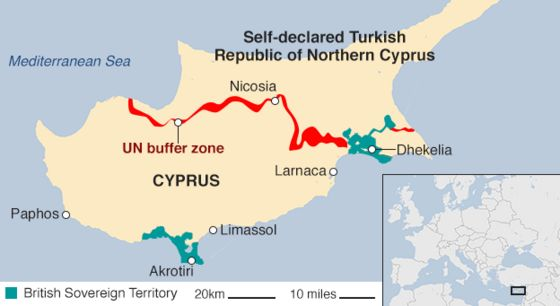
The Mediterranean island of Cyprus is being impacted by the Iran war, which started on Saturday 28 February.Around midnight on Sunday 1st March, a drone, believed to have been launched by the Lebanon-based Hezbollah group, struck the British base of Akrotiri. This prompted a partial evacuation of the military base and of the surrounding villages. Since this attack, two more drones have been intercepted. The attack hit an American plane hangar, believed to be used for its U-2 spy planes.
The attack seemed to have coincided with Keir Starmer, who had previously said the UK would not play a role in the attacks on Iran, announcing that the US could use British military bases to launch defensive attacks on Iran. However, it has since been determined that the attack happened before the announcement was made, and that the British bases located in Cyprus were not included in the agreement for the US to use. On Thursday 5th, Starmer also announced that British F-35s were being launched from the air bases to shoot down drones launched by Iran, headed for neighbouring countries.
The incident raises questions on the security of Cyprus, and how much of a threat the British bases are for the Cypriot population. Neither Cyprus, Greece nor Turkey have launched attacks on Iran, yet Cyprus has become a target, purely for housing the British military bases.
Additionally, the British bases are believed to house a number of American troops and equipment, however, the Ministry of Defence refuses to release any details on this. In one classified US Air Force document, it notes that 87 US Airmen were deployed to the UK bases in 2018. By 2024, the plan was to have 129 US Airmen. Furthermore, the UK also controls other areas in Cyprus, called ‘retained-sites’. They control as many as 15 sites outside of the military bases, and likely also house US troops. This only further threatens the security of Cyprus, as the US is directly involved in the ongoing Iran conflict.
Furthermore, the drone that hit Cyprus contained Russian technology, as reported by The Times, containing “a Russian-made Kometa-B navigation system.” This is the first time Russia has been seen to be involved in the conflict.
The former UK Prime Minister, Rishi Sunak, said, “Cyprus is only a target because of our sovereign bases there.” He further stated to The Times: “It is frankly embarrassing that the French appear to be doing more to protect Cyprus than we are,” referring to how France has sent its strongest aircraft carrier, the Charles de Gaulle, to defend Cyprus.
Furthermore, French President Macron will meet with Greek Prime Minister, Mitsotakis in Cyprus on Monday 9th. However, the UK Government has reiterated that additional troops and equipment were sent earlier this year, in anticipation of the joint US-Israeli attack on Iran. Anti-drone helicopters have also been deployed at the bases since the drone attack.
Greece has also deployed four F-16 fighter jets to Paphos, along with two frigates. Germany’s frigate, the FGS Nordrhein-Westfalen, has also arrived at the port of Limassol. Spain and Italy have also sent frigates to defend Cyprus. Additionally, Turkey has sent six F-16 jets to North Cyprus, which will arrive on Monday 9 March.
The deployment of the Turkish jets seems to signify Greece and Turkey aligning in their views regarding Cyprus’ role in the conflict, and how best to defend it. This cooperation is notable given the historic tensions between Greece and Turkey over Cyprus since the island’s division in 1974. Turkey’s Defence Ministry spokesman, Zeki Akturk, announced that a delegation from the Greek Air Force will visit Turkey on Monday. He described the planned visit as a “confidence-building measure.”
Furthermore, Turkey was the target of a ballistic missile strike from Iran, which was shot down by NATO forces in the region. It has been reported by some as aimed for Cyprus, however, both Turkey and Cyprus confirmed that the missile was aimed at Incirlik Airbase, which is jointly operated by the Turkish and US Air Force.
The island of Cyprus is mainly divided into two, with the Turkish controlling the top third, known as Northern Cyprus, and the Greeks controlling the bottom two thirds, the Republic of Cyprus. Only the Republic of Cyprus is recognised by other foreign governments, with Northern Cyprus only being recognised by Turkey. The UN Peacekeeping Force is also stationed along the divide, known as the ‘Green Line’, which acts as a buffer zone.
While it seems that only Greece and Turkey have control over the island, the British control two large areas of the island, where their military bases Akrotiri and Dhekelia are situated. The areas, officially known as the Sovereign Base Areas of Akrotiri and Dhekelia, were retained by the British when Cyprus achieved independence from the British Empire in 1960.
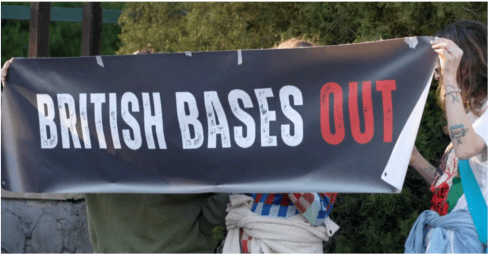
While the bases take up the majority of the British-owned areas, some villages still reside within the British territory. In Akrotiri, the village of the same name still has around 900 inhabitants. The drone attack on the Akrotiri base has brought up the discussion of whether the British should continue to retain and operate military bases on the island, especially as Cyprus itself has become an innocent target in this conflict. Protests have erupted across the Republic of Cyprus, with many calling for an end to the British Sovereign Bases.
Cyprus is an island that has endured many conflicts throughout its history, yet in recent years it has increasingly become a symbol of stability and peace in the region. Across both the North and the South, many Cypriots have long expressed support for a peaceful and unified future for the island. Much of the tension surrounding Cyprus has stemmed from the involvement and interests of external powers.
While the Cypriot population has called for peace, they have had limited influence over the continued presence and control of the British military bases. As the United States and Israel escalate tensions and conflict with Iran, the result risks creating consequences for neighbouring countries, including Cyprus, a nation whose people have consistently advocated for peace.
 York Global Affairs