

UN Conference: Here’s what you may have missed
Isabel Batt
The UN’s 80th General Assembly was held in NYC this September.
The general debate saw all 193 UN member states taking the floor, alongside two observer delegations. Here are the key points:
Palestine & Israel: Bibi shunned by mass delegate walkout
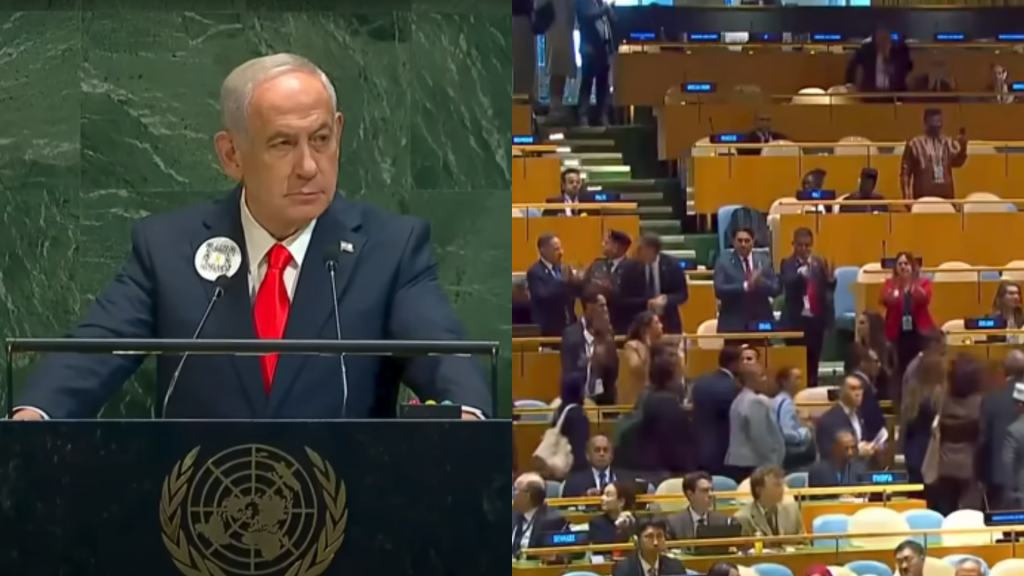
As Netanyahu addressed the UN, dozens of delegates exited, leaving the Israeli PM to address a largely empty room. He sharply criticised the several countries that had recently recognised the state of Palestine, including the UK. He also stated that the speech was being broadcast into Gaza through loudspeakers. Addressing the hostages, he said ‘we have not forgotten you’.
The President of the Palestinian Authority, Mahmoud Abbas, addressed the general assembly via video link after being denied a visa by the United States. He denounced Israel’s alleged war crimes in Gaza, which he called a ‘humanitarian tragedy’. He also spoke about Israel’s occupation of the West Bank, which he criticised as a ‘blatant violation of international law’. Finally, he turned his attention to Hamas, stating that there would be no role for the group in the building of a Palestinian state.
The issue of the war in Gaza dominated coverage of the General Assembly, and talks held throughout the week resulted in several more countries, including the UK, recognising the state of Palestine.
Syria: $10 Million man gets welcome return…

The Syrian President addressed world leaders the UN for the first time in sixty years. Ahmed Al-Sharaa has been interim president of Syria since January, after a rebel offensive overthrew the dictator Bashar al-Assad the previous month. He spoke of Syria ‘reclaiming’ its place and reiterated Syria’s support of the people in Gaza. While in New York, Al-Sharaa also sat down with the US General turned CIA director who arrested him in 2006 for resisting the US invasion of Iraq. The Syrian President was imprisoned for 5 years, and a $10 million bounty on his head was only lifted by the US this past December.
USA: $5.1 billion man… not so much

Trump gave a speech over almost an hour, having been allocated 15 minutes, that highlights his belief in American supremacy and his belief in the infallibility of his own kind of politics. In his own words he is ‘really good at this stuff’. He criticised immigration and renewable energy schemes in Western Europe, claiming that the ‘force of illegal aliens’ would be the ‘death’ of the continent. He also claimed that climate change was the ‘greatest con job’, and in particular took aim at the UK for participating in the green energy ‘scam’. He also stated that the most persecuted religion in the world is Christianity, whilst praising the merits of religious liberty.
Another key aspect of his speech is his belief in the ineffectiveness of the UN as an institution that is able to drive change. He criticised the organisation’s empty words that are unable to end wars. On the contrary, the President claimed that he has personally ended seven wars, for which he argues that he deserves to win the Nobel Peace Prize. Bemused commentators were quick to point out that many of these resulted in a peace that was fragile at best.
Asia: Could Japan’s ardent Thatcherite save the LDP?
Gavin Southway

After Liz Truss’ disastrous 2022 premiership in the UK, it may seem bizarre for any politician to discuss wanting to be Margaret Thatcher’s influence with a straight face.
In Japan, however, the Liberal Democratic Party is going through a period of turmoil: having lost its majority in the upper house in the elections this year, the party held a snap leadership election. While there were five candidates in the race, economics minister Sanae Takaichi was the only woman, hoping to become Japan’s first female Prime Minister.
“My goal is to become the ‘Iron Lady’,” Takaichi said. She is a strong adherent to Shinzo Abe’s (PM from 2012 to 2020) economic structure of low interest rates and heavy government spending to boost Japan’s sluggish economy.
The frontrunner in the leadership race was Shinjirō Koizumi, the suave and charismatic son of early-00s PM Junichiro, and Koizumi remained the favourite with MPs throughout the contest. However, in a race that ultimately gives party members the final say, Takaichi made significant gains in that group, which clinched her the win.
Takaichi’s strong social conservative stances have unnerved some moderate LDP members, who blame Abenomics for the party’s failure in this election. An opponent of same-sex marriage, she is a former Communications Minister who threatened broadcast licenses for channels with “politically unfair” content back in 2016. Takaichi will have to bridge the gap between the LDP’s pro- and anti-Abenomics camps. That is, if the party that has governed Japan for almost the last 70 years wants to avoid a wipeout at the next election.
While the lady may not be for turning, to quote her idol, Takaichi has her work cut out to turn around a polling debacle.
Africa: In Madagascar, they like to rise up, rise up
Mhairi Buchanan

Widespread protests have arisen in Madagascar after two politicians who planned a peaceful protest over chronic water and electricity shortages were arrested.
Anger over the president’s failure to provide these basic services and over these arrests culminated in the formation of a youth-led online movement, known as Gen Z Mada. Joining with other civil society organisations and local politicians, they co-ordinated demonstrations through social media.
Security forces have been using tear gas, water cannons, and rubber bullets to disperse protests. A dusk to dawn curfew has been in place after reports of violence, looting, and arson. At least 22 people have been killed, with a further 100 being injured, although the president, Rajoelina, dismisses this as misinformation. Initially he tried to appease the protestors by sacking his government and proposing dialogue with the youth. However, the protestors are insisting on his resignation amid frustration at economic hardships.
In Madagascar, 75% of the population live below the poverty line and many young people blame Rajoelina for their insecure and poorly paid jobs. However, he now claims that foreign forces are financing the movement in order to initiate a coup and is refusing to step down, despite threats from protestors to take “all necessary measures” to oust him.
Movements made up of Gen Z protesters has rocked many countries this decade, including Indonesia, Morocco, Myanmar, Nepal, the Philippines and Sri Lanka.
Europe: Should the Matignon get a revolving door?
Isabel Batt
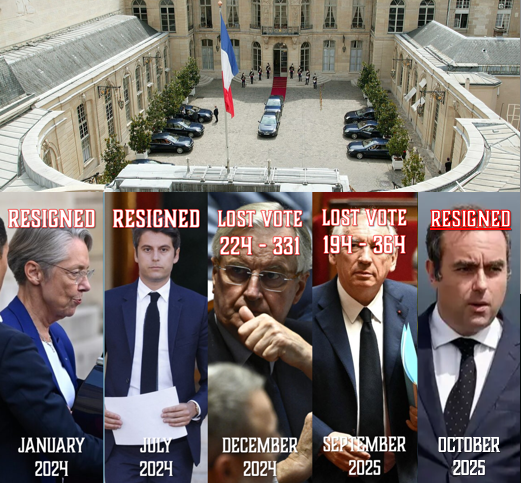
Two weeks ago, I wrote on Sébastien Lecornu’s appointment as Prime Minister amidst France’s looming debt and budget crisis. On Monday, he resigned after less than a month in power – leaving these critical issues unsolved.
The country now faces further political chaos and instability as Macron’s latest Prime Ministerial venture, and arguably his last resort, has failed. France has lost yet another Prime Minister, yet is no closer to solving the debt and budget crisis that looms over the country.
In his resignation speech, Lecornu criticised the inability of French politicians to come to a compromise on budget issues, saying that the parties need to ‘cast [their] egos aside’, and blaming the ongoing crisis on the ‘partisan appetites’ of those in Parliament. His resignation comes after criticism of his decision to appoint Bruno Le Maire as defence secretary, who is viewed by Les Républicains as the father of Macron’s economic policies. Le Maire has since stepped down.
Both sides of the political spectrum are now asking for President Macron to resign, however, a resignation from Macron seems unlikely, as he has always been insistent that he will see out the remainder of his term until 2027.
After resigning, Lecornu accepted a request from Macron to create a ‘stability plan’ for France by the evening of Wednesday October 8 th . If this does not succeed, the President must decide whether to appoint a new Prime Minister or dissolve the Assemblée Nationale. What Macron’s choice will be remains to be seen.
 York Global Affairs