
Asia: “To vote for your Prime Minister, react to the message below”
Gavin Southway
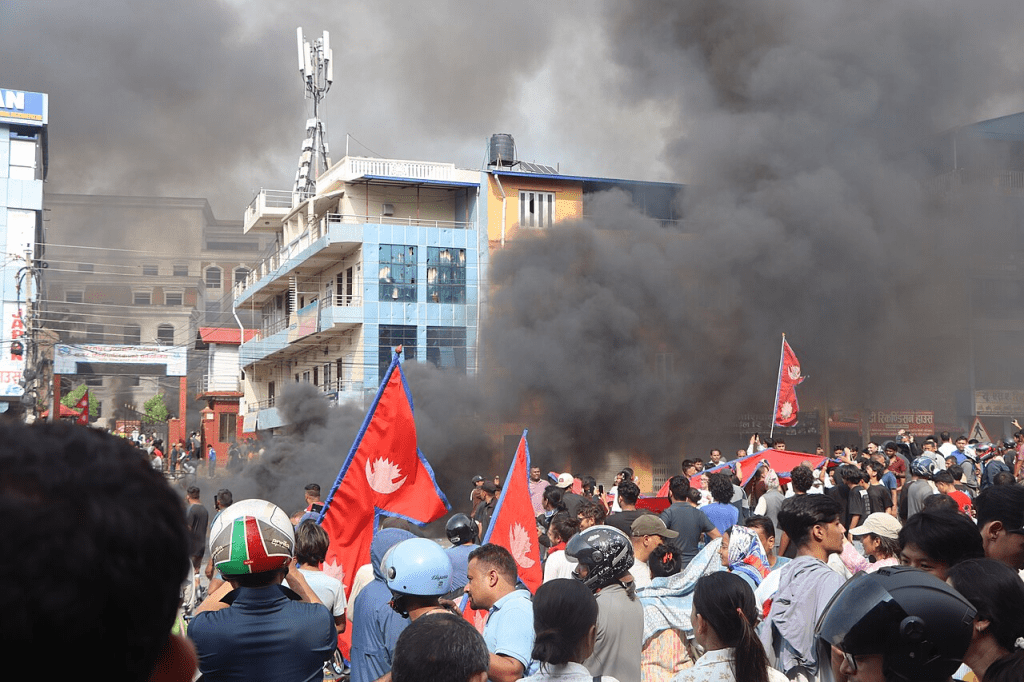
Five days of intense protests erupted in Nepal this month, with hundreds of youth protesters successfully forcing out the current administration.
Allied under the “Gen Z” banner and organised by social media-savvy Nepalis, the stated mission of overturning a proposed social media ban (circumvented by VPNs) obscured a different objective. In a country where the average wage is just over £1,000 a year, Nepal’s leaders and their families, dubbed “Nepo kids” for their fancy lifestyles and connections, flaunted Louis Vuitton and Cartier goodie bags on the socials. How the other half live.
So thought many Nepalis, who, encouraged by influencers, took to the streets. Energised by last year’s revolution in Bangladesh, culminating in a new youth political party, they forced the hand of PM K.P. Sharma Oli. Parliament was burned, damage to businesses ran into the millions and 72 died.
Just like 2022’s youth movement in Sri Lanka, which toppled the presidency there, Gen Z beat the old guard. Snap elections have been called for 2026. Army chiefs soon asked earthquake relief NGO Hami Nepal, part of the protest movement, to nominate a PM. After hours of (online) debate, judge Shushila Karki, seen as an independent face, was elected Prime Minister via Discord vote: truly a sign of the times.
Nepal’s protests share similarities with grievances in Indonesia and the Philippines – a disaffected youth gathers to force concessions from the government. The new, originally leaderless administration has just months to rebuild and unite a country that, for a few days, was run fully online.
Europe: France gains fifth PM in just two years
Isabel Batt

The issue of debt management and budget creation in France has claimed yet another Prime Minister this September, after François Bayrou failed to get his budget approved and was forced to resign after losing a vote of no-confidence.
Sébastien Lecornu has since been named the fifth French Prime Minister in two years, amongst an ongoing dispute about how best to manage France’s looming debt crisis. In 2024, France’s budget deficit reached 5.8% of its GDP, and the cost of servicing this debt is now estimated to be around €67 billion a year – more than the amount spent by governmental departments other than education or defence. It is a growing possibility that if France cannot cut spending and control its debt, the country will have to turn to the IMF or the ECB for assistance. This is a problem that has cost France its previous two PMs and will be the making (or breaking) of the incoming leader.
On September 10th a day of protests was organised by the group Bloquons Tout, as a show of anger against the political classes inability to solve the crisis. An estimated 175,000 protesters took part across the country mostly peacefully, but with some reports of tear gas being fired near Gare du Nord in Paris and a bus being set on fire in Rennes. A more general strike took place on 18th September with most trade unions taking part. This was planned before the no-confidence vote and is in response to a Government that French people believe is out of touch with their day-to-day life. A strike by air-traffic controllers was planned for the same day but was rescheduled for October.
It will not be easy for Lecornu to solve. He is facing a fragmented Assemblée Nationale with no specific ideological majority, and parties on either side of the political spectrum refusing to make concessions. Lecornu, therefore, has the difficult task of crafting a budget plan that is agreeable to both the strongly right-wing Rassemblement National (RN) and the strongly left-wing La France Insoumise (LFI), while he is a staunch Macronist. If France does
not want to face further economic issues, the major parties will need to come together and agree on a budget that tackles the issue of the country’s debt.
Europe: Artificial Governance?

Albanian Prime Minister Edi Rama has appointed the world’s first artificially
generated minister, known as Diella (translating as “sun” in Albanian).
Her key role within the cabinet is to crack down on corruption. All decisions over who wins public tenders will be removed from government ministries and transferred to Diella, who will objectively assess the merits of each company. Rama claims that this will ensure transparency and remove corruption. This is part of Albania’s bid to join the EU, for which the main precondition is that they address corruption. Rama’s party has promised to achieve membership by 2027.
82 out of 140 voted in favour of Rama’s cabinet, despite protests from the
opposition. They argue that this is unconstitutional because the Constitution states that a government minister must be a mentally competent citizen over the age of 18.
Diella justified her position in a parliamentary address by saying “The constitution
speaks of institutions at the people’s service. It doesn’t speak of chromosomes, of
flesh or blood”.
Rama has not provided details of human oversight for the bot, nor has he addressed concerns that Diella could be subject to manipulation by a human.
 York Global Affairs
1 Comment