
Debrief on the Uyghur: Media Coverage vs. Current Realities
by Archisha Gupta
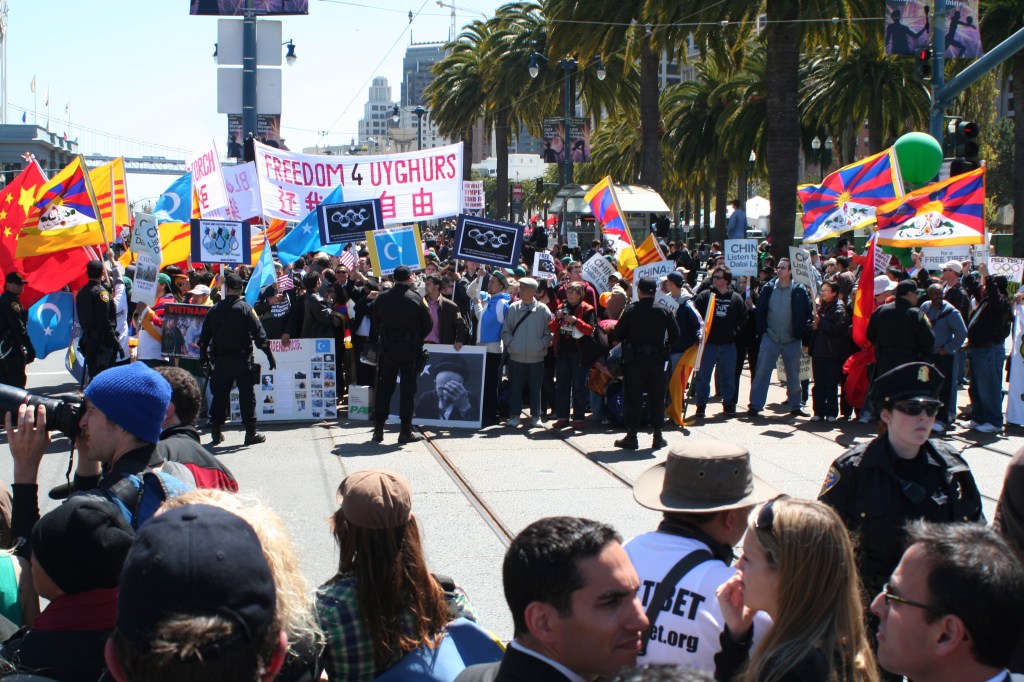
A 2008 protest in San Francisco calling for freedom for the Uyghurs and Tibet. (Image Credit: John Martinez Pavliga, Flickr).
Introduction
The Uyghur human rights crisis in China’s Xinjiang region attracted global media attention from 2018 to 2021, revealing mass internment camps and widespread abuses such as forced labour and cultural suppression. Despite strong condemnation and media coverage, the situation remains severe as of 2025, with ongoing violations and little accountability. This debrief will assess media effectiveness and the current situation in Xinjiang.
Peak Media Coverage and Global Response
From 2018 to 2021, many mainstream media covered their reports of the Uyghur exposing the Chinese government on the treatment of the Muslim minority. It was reported that between 1 to 1.8 million Uyghurs and other Muslim minorities were detained in “re-education camps”. Various sources, such as drone footage, survivor testimony, and leaked records, showed the true horrors of this region, including forced labour, cultural erasure, and the coercive birth control measures in the Xinjiang region. This prompted responses from various global actors. For instance, the US passed the Uyghur Forced Labor Prevention Act in 2021, which prevented the importation of products from the Xinjiang region to discourage forced labor toward the Uyghur. Another instance is corporate pledges to the public. An example of this came in 2020, when Apple and Nike pledged to cut ties with suppliers who are alleged to be using “forced labour” in the Xinjiang region from the Uyghur people. However, this has come into current media scrutiny. In 2023, Canada conducted an investigation into Nike and Dynasty Gold due to allegations that both companies were utilising forced labor linked to Uyghur individuals in their supply chains even though they claim they no longer have these ties. Reports have also been spread, and the region was thoroughly investigated at the peak of media coverage. This includes the United Nations (UN), which created a report highlighting the human rights violations under International law. They also present the arguments claimed by the Chinese government, stating the camps are for educational purposes and not concentration camps. They also mention that measures such as birth control in the region were not to suppress the ethnic minority. Yet the focus has shifted and some changes may no longer be enforced, with limited impact on Uyghurs in Xinjiang.
The Current Situation in 2025
Regardless of the recent decrease in media coverage in the area, the Uyghurs still suffer. There are still persistent human rights violations in the region. The Chinese government claims that the “re-education camps” are no longer running; however, satellite footage suggests that these facilities are still operating. While it is true that not all the camps are running, a recent report claims that hundreds of thousands of Uyghurs remain incarcerated under vague charges related to “extremism.” Moreover, according to statistics collected by the labour rights group in 2024, it was estimated that 500,000 to 800,000 Uyghurs were forced into labour across various industries, ranging from big corporations to agricultural labour. In light of the new development of AI, it has been claimed that advanced AI has been used to surveil the Uyghurs. This included phone usage, religious practices, and personal movements through an extensive digital police state. Additionally, Uyghur culture has been disappearing. This included language that has been heavily restricted and deemed not to be used as a means of communication amongst the people. Furthermore, there has been a significant decline in mosques and cultural sites in the region. Lastly, research was conducted and found a 48.7 percent drop in Uyghur birth rates between 2017 and 2023. This suggests the continued enforceability of birth control in the region beyond these unchanged violations, this region is still violating human rights on a day-to-day basis. This includes political indoctrination. Former detainees report being forced to study and recite Communist Party doctrine regularly. Another persistent problem is family separations. Uyghur children are still being placed in state-run boarding schools where they are forcibly assimilated into Han Chinese culture instead of being with their parents.
Media Coverage’s Impact: Why has little changed?
Despite the strong media coverage, the question remains as to why nothing has changed. There are a few factors that contribute to the unchanging circumstance for the Uyghurs. Firstly, it can be argued that China’s economic and political influence can have an impact on the Xinjiang region. In the political context, China is one of the most powerful countries in the 21st century. With this influence, China has pressured other governments and corporations to avoid the issue of the treatment of Uyghurs. Moreover, many corporations and countries are reliant on Chinese trade, including the global south and part of the EU. A report from Uyghur Rights Monitor, Sheffield Hallam University, and the Uyghur Centre for Democracy and Human Rights reveals that major brands like H&M and Zara are at high risk of sourcing cotton and PVC produced by Uyghurs in state-imposed labour transfer programs. Due to dependence on Chinese trade, a large majority refrained from taking strong action. Secondly, it can be said that with influence, China has control over information. A lot of what has been reported from the region was leaked from various sources and the information wasn’t made available by the government. This results in strong restrictions for journalists accessing this area, making it hard to report.
Furthermore, within the country of China, many citizens don’t know what is going on, as the Chinese government has dismissed mainstream Western media, calling it “Western propaganda”. Lastly, a reason for the unchanged circumstance in the region can be due to the lack of effective international effort. While many countries and corporations have implemented anti-forced labour measures, it has not been strictly enforced. For instance, in 2024, a report from Human Rights Watch highlights several global car manufacturers, including General Motors, Tesla, BYD, Toyota, and Volkswagen, that have come under scrutiny for their inadequate measures to address the potential use of Uyghur forced labor in their aluminum supply chains.
Conclusion
Despite significant media coverage, meaningful change for the Uyghurs remains elusive. Advocacy has led to some sanctions and corporate disengagement, but China’s political power protects it from accountability. Now, in 2025, the oppression and forced labor of Uyghurs continue largely unchecked. Without sustained international pressure, this crisis may fade from public awareness. We must stay committed to addressing these urgent human rights concerns.
 York Global Affairs