
The ‘Cult of Personality’ in Turkmenistan
by Mhairi Buchanan
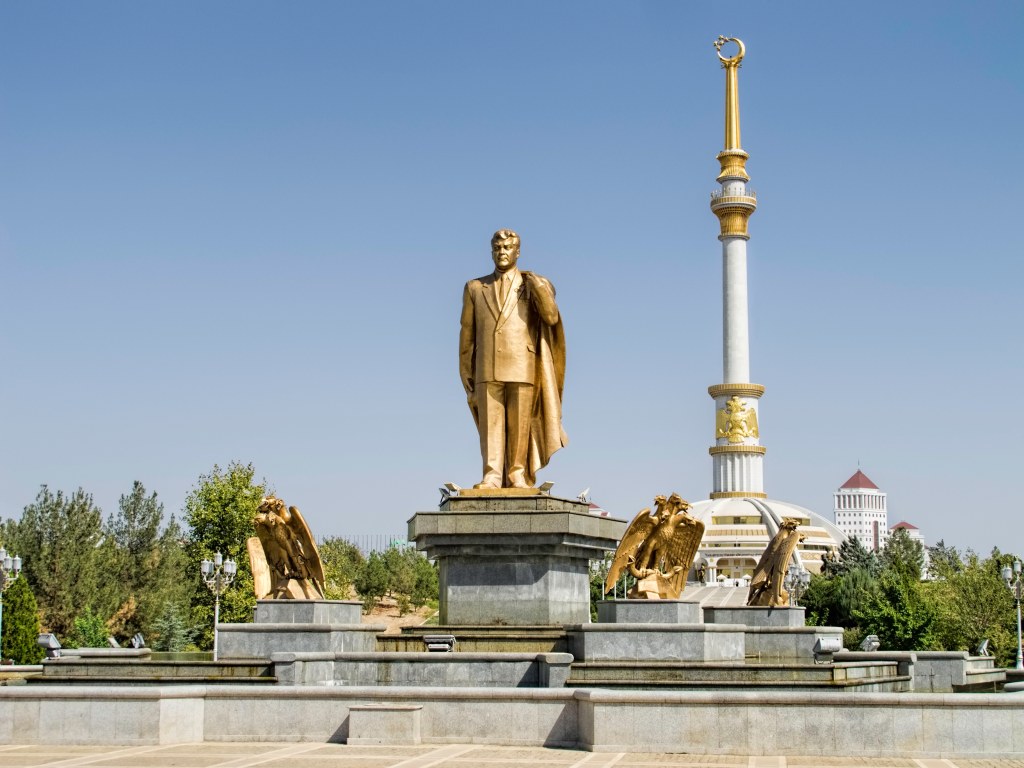
A golden statue of former President of Turkmenistan Saparmurat Niyazov in Ashgabat. (Image Credit: Dan Lundberg, Flickr).
A “cult of personality” is widely regarded to be an attempt to elevate a leader to hero or even God-like status. This is done through carefully curating their image and demanding worship rather than earning respect from the populace. Throughout time, leaders from all over the world have achieved this through grandiose and excessive projects, often at the expense of their own people. This was seen in China in the 1950s regarding Mao Zedong, in Iraq regarding Saddam Hussein, and more recently in the USA regarding Donald Trump with his MAGA campaign.
However, today we will be looking at a country overlooked in the Western media, perhaps as a result of its meagre freedom of press, expression, and media rights. Turkmenistan has an assortment of problems, and on account of its string of narcissistic presidents, these aren’t getting any better. Nearly all of the wealth generated through the country’s vast gas reserves is wasted on fuelling the pride of such men when ordinary people are unable to access necessities such as water. The situation in Turkmenistan will thoroughly shock the uninformed reader: it is the epitome of vanity, made even more stark when set against the backdrop of the deepening deprivation faced by the country.
Before I move on to current affairs, it is important first to give a brief history of the circumstances that led Turkmenistan to where it is today. Turkmenistan became a part of the USSR in 1925, having been part of Russian Turkestan since 1881. During Soviet rule, there was less desire than in Eastern European states for independence, so when independence was achieved in 1991, it was easy to maintain one-party rule without uprising. The government just changed the ideological cover from socialism to Turkmen nationalism.
In this context, it was easy for Turkmenistan’s elites and its first president, Niyazov, to continue undermining political freedoms in order to maintain authoritarian control and create a cult of personality for himself. From winning his first election with a supposed 99.5 percent of the vote in 1992 to declaring himself “President for life” (effectively doing away with any kind of elections), Niyazov has never made any credible effort to even farce democracy. The dystopian actions of this egotistic dictator are shocking and laughable upon first reading. He coined himself the nickname “Turkmenbashi” which translates to “the father of all of Turkmenistan”. He had the months of the year renamed after himself and his family members. He had a giant (250ft) golden statue of himself which rotates itself so that it is always orientated towards the sun erected in the capital Ashgabat. He made his book, The Rukhnama (a propaganda tool describing Turkmen origin and morals) mandatory reading for high school children, university students and even anyone seeking to pass their driving test. These facts seem ridiculous and even a bit comedic, until you contemplate that for Turkmen people these aren’t the distant antics of a narcissist. It embodies the authoritarian regime that they are living under and their powerlessness to change their draw in life. It’s hard to believe that the statue would elicit anything but dread and disgust.
Surprisingly, following Niyazov’s death in 2006, the transition of power to his deputy prime minister, Gurbanguly Berdimuhamedov, was smooth. Unfortunately, Berdimuhamedov, had equally little interest in improving living conditions for the Turkmen population, and equally as much interest in creating his own cult of personality. He coined himself the nickname “Arkadag” or hero protector, and where possible he attempted to one-up his predecessor with his grandiose projects, although largely using the same blueprint for his cult. He exceeded Niyazov’s outrageous statue by replacing it with one of himself on horseback, although his is only a meagre 75ft. He replaced Niyazov’s book with his own in the school curriculum. He invested in many other prestigious, wasteful projects, such as a $2.3 billion airport, and a lavish tourist zone on the Caspian Sea, despite the lack of tourism (and the continued difficulty in obtaining a visa). He even erected a golden statue of his favourite dog breed, the Alabay, atop a base of television screens playing footage of said dog breed.
However, his largest legacy is likely to be the construction of a smart city in the south of the country, named Arkadag, after himself. Soon after the $5 billion city was officially made regional capital in December 2022, it was realised that the city could not be complete until it had a football team. Therefore in 2023, having obtained the majority of Turkmenistan’s national players, the new team competed in their first competitive tournament in the country’s top division, and won every single match (albeit with some questionable referee decisions).
These men, the supposed “father of Turkmenistan” and the “hero protector”, have wasted the country’s resources and wealth where they are already scarce. Not only is Turkmenistan faced with deprivation on account of the maldistribution of wealth, but its unfortunate geography means that the whole country is practically a desert. In this context, the grand fountains that decorate the streets of Ashgabat seem even more misplaced.
However, Gurbanguly passed the Presidential title onto his son Sedar, hoping to offset the tedious tasks of domestic politics and allow more time to focus on international issues. Prior to offloading his presidential title, he had set up an upper chamber of parliament – specifically designed to be ruled by himself. However, not long into Sedar’s presidency, Gurbanguly’s plan was already going wrong. Sedar’s character was stronger than he had anticipated, and he was welcoming many high-end guests and making trips himself to China, Russia, Kazakhstan and the like. Trying to outdo his son, Gurbanguly visited Japan, Russia and South Korea in one year, ensuring he was always greeted by presidents and prime ministers upon arrival.
Sedar also went after many members of his father’s family, forcing his cousins into exile and removing his aunt from her position of power in the Red Crescent. Eventually Gurbanguly had enough and reformed the upper house in a way that gave it unlimited powers and meant that all decisions had to go through him. This essentially reversed the power transfer that had happened only a year ago when his son became President.
Therefore, Gurbanguly continues to retain tight control of the country, meaning that Turkmenistan may still have years left of being subjected to poverty in order to fund his extravagant projects. Who knows in what ways his son will try and outdo the legacy of his father when the 68-year-old inevitably passes on?
 York Global Affairs