
M23’s Gambit: The UN’s Struggle for Peace in the DRC
by Kaila Nkufo
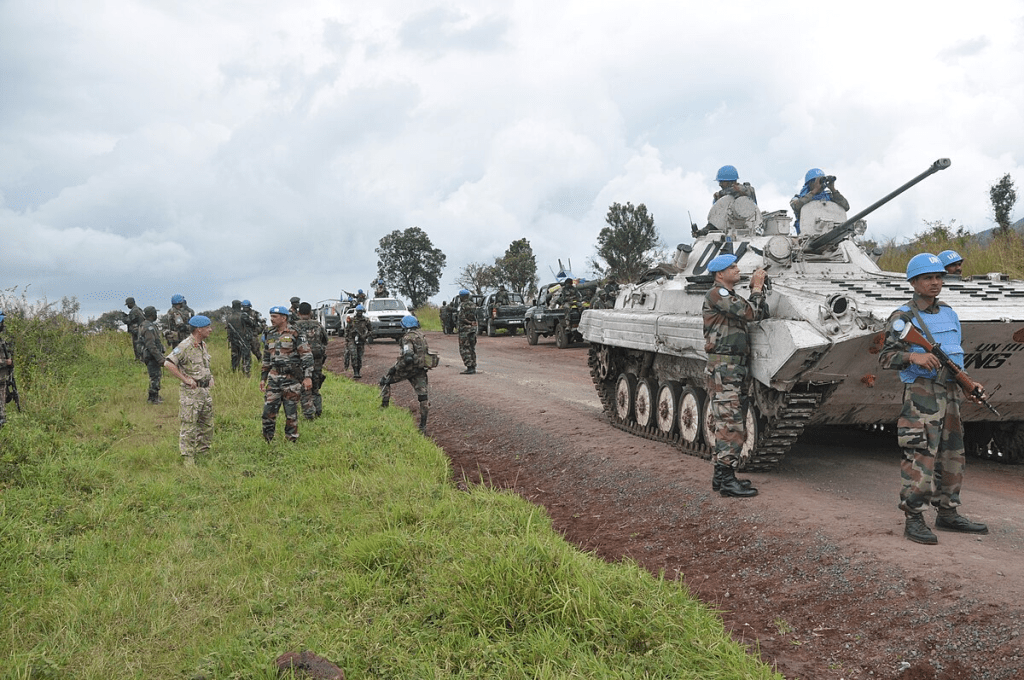
MONUSCO peacekeepers in North Kivu province in 2012. (Image Credit: MONUSCO Photos, Wikimedia Commons.)
M23’s escalation and the UN’s ongoing involvement
In late January 2025, the M23 rebel group seized Goma, the largest city in eastern Democratic Republic of Congo (DRC), which also serves as a nucleus for security operations and humanitarian assistance. This marks a significant escalation in the conflict that has plagued the country for over four decades, rooted in the legacy of King Leopold’s colonial rule, which ended in 1909.
Despite the UN’s plan to withdraw its largest peacekeeping mission, MONUSCO, by December 2024, the mission remains in the country. In some cases, peacekeepers have been drawn into direct combat alongside the Southern African Development Community mission and the Congolese Armed Forces, leading to the deaths of 13 UN peacekeepers in January 2025. The siege of Goma, allegedly supported by Rwanda, has further heightened tensions, resulting in the severing of diplomatic ties between Rwanda and the DRC. In response, the Congolese government has declared that the attack constitutes a declaration of war by Rwanda. On 26 January 2025, the UN Security Council (UNSC) summoned an emergency session, urging both countries to engage in political negotiations to resolve the crisis. This was followed by a UNSC resolution on 21 February 2025, which expressed grave concern over the rapidly worsening security and humanitarian situation in the DRC, particularly in the wake of M23’s offensive and its alleged coordination with Rwandan militia.
M23’s advance and the Goma crisis
The rapidly deteriorating security crisis has raised diplomatic and legal concerns, including whether the deaths of 13 peacekeepers constitute war crimes, the legality of force used by peacekeepers, the application of the law of occupation with M23 controlling cities like Goma, and whether Rwanda’s support for M23 has escalated the conflict from a non-international armed conflict (NIAC) to an international armed conflict (IAC).
The M23, composed of former rebels from the National Congress for the Defense of the People (CNDP), emerged in the DRC in the early 2010s. Responsible for numerous violations of international law, including sexual violence, attacks on civilians, and child conscription, the group claims to protect the Tutsi ethnic group in Congo and Rwanda, particularly against Hutu rebels who fled the 1994 Rwandan genocide. Despite Rwanda Defence Forces (RDF) denial of support, UN reports confirm their involvement, including supplying weapons and deploying troops alongside M23 in eastern DRC. Estimates by the UN Group of Experts suggest that around 4,000 Rwandan troops were operating with M23 in June 2024.
This is not the first instance of widespread violence caused by M23. The group had briefly captured Goma in 2013, before being ousted by the UN’s Force Intervention Brigade (FIB) that same year. M23 resurfaced with significant force in 2022, taking control of towns like Rubaya in North Kivu, a key coltan mining hub. Over the past two years, M23 has expanded its territorial ambitions, contributing to the current crisis surrounding the DRC’s peacekeeping mission.
Goma’s recent capture has raised questions about the effectiveness of MONUSCO, the UN’s longest-standing peacekeeping mission in the DRC, active since 2010. Despite calls from the Congolese government and civil society for MONUSCO’s withdrawal, citing its failure to stabilize the country, the mission’s mandate has been repeatedly renewed. This escalating violence makes a full withdrawal increasingly unlikely.
Legal and Diplomatic Concerns
The M23’s actions present significant challenges for the UN, MONUSCO, and its adherence to International Humanitarian Law (IHL).
A. The Peacekeeping Dilemma
MONUSCO’s involvement raises questions about the UN’s peacekeeping principles, particularly: 1) maintaining neutrality while cooperating with combatants like the Armed Forces of the DRC and the Medical Assistance and Emergency Intervention Service, and 2) the use of force by peacekeepers. MONUSCO’s mandate is among the most expansive in UN history, allowing it to use “all means at its disposal” to protect civilians. In January, this included launching ‘fire missions’, which involves requesting artillery or other indirect fire support to target and strike specific enemy positions, against the M23 to curb their territorial expansion. Although a deeper discussion of these issues is outside the scope of this article, the primary concern is that the broad interpretation of MONUSCO’s mandate – and its involvement in ongoing violence – puts peacekeepers’ safety at risk, exemplified with the loss of 13 peacekeepers in January.
B. Withdrawal Uncertainty
The recent violence has further delayed MONUSCO’s planned withdrawal. Prior to the M23’s resurgence, both the Congolese government and civil society had called for the UN’s exit. A rapid withdrawal plan was agreed in 2023, resulting in MONUSCO’s pullout from some eastern provinces, though no specific deadline was set for complete withdrawal. However, during the mandate renewal in December, the government refrained from demanding an immediate departure, extending the mission’s mandate until December 2025. Given the current situation, it seems unlikely that MONUSCO can withdraw until stability is restored, raising concerns about the potential vacuum left by the UN’s departure.
C. International Humanitarian Law (IHL) and its application
The application of IHL is crucial. It is widely accepted that IHL applies to UN peacekeepers in armed conflict. This includes protecting peacekeepers and their equipment from attacks and ensuring peacekeepers adhere to IHL when engaged in combat. The key issue here is determining which set of rules applies – those for International Armed Conflicts, Non-International Armed Conflicts, or both. This largely depends on the degree of Rwandan involvement with the M23.
MONUSCO moving forward
During the January emergency meeting and the 21 February UNSC Resolution, there was strong emphasis on halting hostilities and finding a political resolution. The challenge lies in convincing all parties to pursue this route. One strategy might be to increase political and economic pressure on Rwanda. UK Ambassador James Kariuki suggested that any attacks on MONUSCO peacekeepers could justify UN sanctions. However, this comes with some irony, as the UK had previously pursued a controversial asylum agreement with Rwanda. While sanctions were placed on Rwanda in 2012, the country’s economy has grown significantly since then, which raises questions about the effectiveness of those sanctions. It is unclear whether the Security Council will support them now. A critical step could be the EU’s suspension of its minerals deal with Rwanda, as supported by the European Parliament’s condemnation of the situation. The US has already imposed sanctions on Rwandan officials, but Rwanda continues to reject them, calling for a diplomatic solution with more decisive international action.
 York Global Affairs