
Ukraine’s winter ahead: Why Biden’s latest weapons shipments could spell the war’s end
by Joe Langham
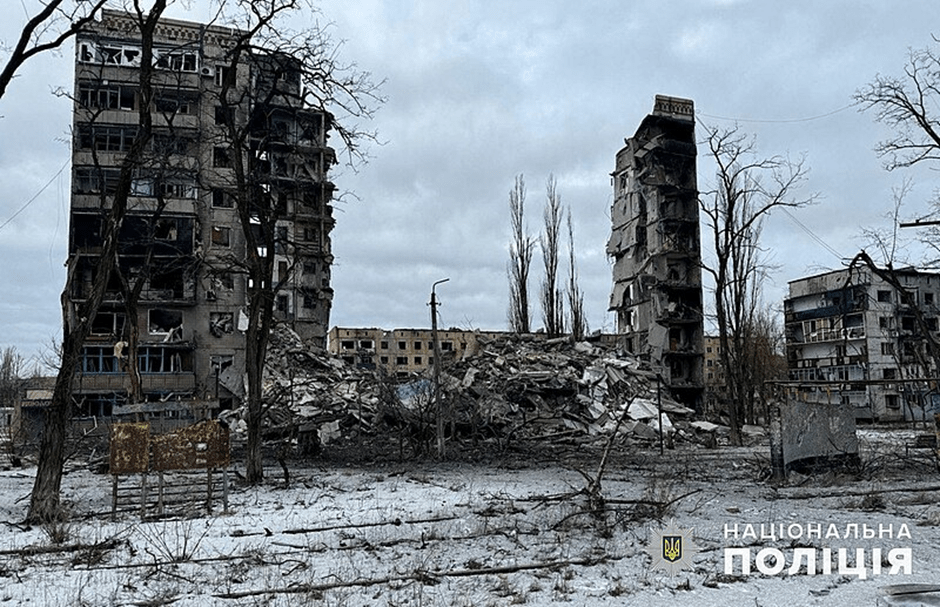
An apartment block in Avdiivka, Donetsk Oblast, destroyed by Russian bombing in 2022. Image Credit: National Police of Ukraine, Wikimedia Commons
In Ukraine, winter is setting in. As the temperatures fall towards freezing, the solid ground makes trench-digging more challenging, while favouring the manoeuvring of tanks and armoured vehicles. This was one of the many problems of the February 2022 invasion; a mild winter meant soft, muddy ground, such that much of the Russian assault was funnelled into long columns of vehicles restricted to the roads. Having seen off much of the invading forces, the Ukrainian army defended their capital and proved to the West to be a force worth backing. Today, Russia occupies just under twenty per cent of Ukraine’s huge land mass. The problem is, this was broadly the same story a year ago. In that time, the front line has not moved to any significant degree, the exception being the recent Ukrainian incursion into Kursk. While stalemate has appeared to characterise front line shifts in the past twelve months, recent changes have moved the line in Russia’s favour.
Despite the controversy and political wranglings associated with providing military aid and assistance to Ukraine across the West since the start of the war, the material support provided has only strengthened. In particular, a range of Man-Portable Air Defence Systems, namely thousands of Javelins, proved extremely effective against Russian tanks and armour. Armoured Vehicles including hundreds of US-made M3 Bradleys, as well as Main Battle Tanks such as the M1 Abrams, and the German Leopard and Leopard IIs have also made their way to Ukraine. High Mobility Artillery Rocket Systems (HIMARS) and Patriot missile defence systems have proven a significant boost to Ukrainian strike and air defence capabilities since their deployment in 2023. Western support for Ukraine has clearly been crucial and is doubtless responsible for a serious degradation of Russian forces as well as Ukrainian survival. However, it has not translated into battlefield victories; this is in part because, despite the range advanced weaponry the West can supply, it cannot send troops. Manpower is a serious problem on both sides, but is all the more serious for Ukraine and Volodymyr Zelensky, whose eye is surely also on the need to have a viable and capable force of working-age people able to rebuild the country after the war’s end.
And end, it will. As the dark days of winter draw in, it is not only Russian encroachments on the front line that test the Ukrainian capacity to continue, but also the rolling blackouts and continual aerial assault on energy infrastructure that mean that the war is felt nationwide. The victory of Donald Trump in the US presidential election on 5 November appeared to confirm the course of the war in the same direction; a few days later, Zelensky went on Ukrainian radio to confirm that this would mean a faster end to the war and, crucially, that ‘We must do everything to ensure that the war ends next year through diplomatic means’. Though Zelensky’s earlier rhetoric in the war argued for the recapture of all occupied Ukrainian territory, including Crimea, he clearly understands that the reality of the situation will force his hand, and that military victory is no longer possible. While later clarifying that Ukraine would not accept occupation of its territory in any diplomatic settlement, this would surely amount to total Russian surrender and withdrawal. At the very least, this would exact an incredibly high price in any peace talks and is likely to be impossible.
The latest arms allowances to Ukraine also point to the inevitability of diplomatic settlement. On 17 November, President Biden permitted the use of long-range weapons to strike targets inside Russian territory, namely the US-made ATACMS missile system, and British Storm Shadow missiles. It was barely over two months ago that Keir Starmer departed talks with Biden in Washington DC rather disappointed, having failed to gain his assent for this precise usage. So, what changed? For the United States, it is ostensibly the Ukrainian incursion into Russian territory in the Kursk and subsequent deployment of North Korean troops to defend the region. The far more likely reason is Trump’s imminent return, and his determination to end the war. That being said, Biden’s decision is more than just a Hail Mary on behalf of the Ukrainians; it is a concerted effort to solidify their bargaining position in future negotiations. For the same reason, Biden has also permitted the deployment of anti-personnel land mines to the front lines. Land mines are not an offensive weapon, they do not signal intent for a ‘final push’. Put together, these weapons deployments are there to press pause on the conflict, to deter Russian advances, enhance the Ukrainian position, and give Russia a reason to come to the negotiating table. Should Russia be permitted to continue its advances and secure the upper hand, it would be far less likely to have reason to resolve the conflict.
It is fair to say that Putin has not responded well to recent developments, initiating renewed bombardments on Ukrainian infrastructure, and debuting a new intermediate range ballistic missile on 21 November. He has issued stark and serious warnings to the West, accusing them of escalation and making it clear he now considers military structures of complicit states as legitimate targets. It is easy to write this off; as ex-NATO Secretary General Jens Stoltenberg pointed out in September, ‘There have been many red lines declared by him before, and he has not escalated’. Moscow called these comments ‘dangerous’, naturally arguing that Putin’s threats were very real. Certainly, Putin has repeatedly failed to deliver on his threats – including nuclear ones – but the truth is that no-one can know when he will decide to put his foot down.
Biden’s latest gifts to Ukraine could be a godsend for the state of future negotiations, dangerously escalatory, or both. But a final question nags: If the Biden administration seeks a negotiated settlement over Ukraine’s future, and is preparing for that eventuality, then why wait? Why leave the nature of that settlement up to Trump, a self-proclaimed Putin fanboy, and give him the opportunity to reshape and undo what has already been achieved? The answer is probably that, with mere weeks to go, the Biden presidency can offer no lasting guarantees or assurances; perhaps this is all he can do, in the hope that it cannot be fully undone. Instead, however, he should be prepared to lay the groundwork of future agreements, and orient his policy towards being simultaneously pro-peace, and pro-Ukraine. For the sake of his own legacy, and Ukraine’s future.
 York Global Affairs